Sunday, August 3, 2014

Can You Wear This Hot Hair Trend?? YES!! What You Need To Know To Rock these Hair Colors

What's the hottest hair trend right now? It's candy-colored vibrant hair! 
This style has a way of transforming any outfit into a fashion statement. 
It's a bold, stylish way to showcase your individuality and have  everyone doing a double take.  HHere is a  guide to rocking this cool hair trend the right way!


HOW TO CHOOSE YOUR COLOR


• Pick a color you like and can wear easily. Stick to a "neutral" pastel color such as pink, peach, blue, violet, mint, etc. It will be easier to match your clothes and accessories with a softer color.
• Stick to one shade of color. If you want to get creative and dye your hair two different colors, be sure the colors blend well together -- such as blue and purple or blue and pink. Don't go for more than two colors at first.

• Make sure the color complements your skin tone. "Your skin tone is the basis to your hair so you want to make sure they complement one another," says Madame Claude. Does your skin have warm, more yellowish tone or does it have a cool, more pinkish tone? The more contrast between your hair color and skin tone, the more dramatic your look will appear. If you choose a hair color that is similar to your eye color or complements it, the combination will give a more natural look. It all depends on the look you are going for, not everyone wants the natural look.
• Consider different ways to highlight the hair. Think about whether you want to dye your hair one solid color or highlight it. Ombre gives a more natural blended look which starts with a darker color at the root of the hair to a lighter finish at the end using the same color tone.

• Make your  consultation with our stylist colorists. Choosing a hair color can be difficult and terrifying at the same time. If you're permanently dyeing your hair, you want to make sure you speak to our stylists about the color as well as the safest way to do it.


HOW TO MAINTAIN YOUR COLOR
To get candy-colored hair, you most likely have to bleach or use high lift tints on your hair. Bleaching your hair eliminatessome of your natural oils. Here are Madame Claude's tips on how to maintain and/or restore your hair's health after any high lift coloring


• The colder the better. It is better to wash your hair with cooler water.
• Use sulfate and parabin - free shampoos.
* Use the recommended  products (shampoos, conditioner, styling products and serums that your stylist recommends
• Use a deep conditioning treatment for your hair every time you wash your hair
• Avoid washing your hair everyday. Try to go some time between washes. If your hair gets dirty easily, use our recommended dry shampoo -- it can be a lifesaver.
• Put vinegar in your hair after dyeing it. Research shows that applying vinegar to freshly dyed hair can help the color hold better.
• Use heating tools properly. Such as hair straighteners and curling irons. Ask your stylist about the proper way to use your iron on your hair
• Use hair serums. Hair serums coat your hair and protect it from the heat caused when styling it. It also prevents everyone's worst nightmare: FRIZZ


HOW TO GET CANDY-COLORED HAIR WITHOUT DYEING IT

If you are not ready or do not want to commit with coloring your hair with high lift you can try some of these alternatives to permanently dyeing your hair

• Hair Chalking. Hair chalking is a quick, simple and an inexpensive alternative to dyeing your hair and it will wash out.
• Color hair extensions. These extensions will add that pop of color to your hair without having to color your own hair.


Monday, May 5, 2014

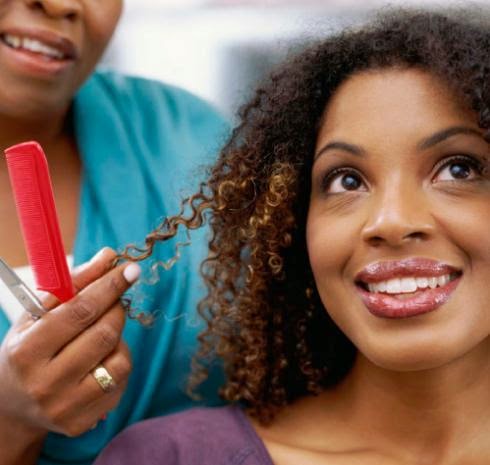
The Ten Commandments of Curly Hair and the Best Cutting techniques for Curly Hair


1. TOO MUCH TOUCHING. Curly hair does not react well to touch. Actually the more you run your hands through the bouncy locks, the more the roughing up the cuticle layer, causing more frizz and collapsing the curl.

2. DRINK UP. Curls need moisture! LOTS of moisture. When searching for curly hair products look for brands featuring high quality ingredients with a variety of oils to leave curly hair feeling vibrant and luxurious.

3. THE MORE THE MERRIER. Layering products creates a great effect for curls. For example, start with a leave in conditioner to balance the hair's moisture and eliminate frizz then go to a defining product to add fullness and movement rather than cocktailing the two together each product serves a purpose!

4. NO WET DOG LOOK. The infamous scrunch look is not desired by many but ends up being the result. No one with natural curls should look like they were left out in the rain.

5. WATCH OUT FOR THE LENGTH. Curly hair can be deceiving because you won't notice the growth until your "once in a blue moon" blowout, but the dead ends are still there and need to come off. A regular trim will bring back shape and life to the style.

6. BE AWARE. Not all curls are equal! Growth patterns and texture are different all over the head but especially with curls. Using products that not only enhance curls where needed, but also tame frizz .
7. START FRESH. Product build up will cause curls to loosen or flatten out. This can happen with any hair type. But when you notice your curls just aren't springing up like normal, make sure to cleanse the hair thoroughly prior to styling and check for waxes and silicones on the ingredient list of your at home product regimen.

8. CONFIDENCE IS KEY. For clients going natural, they are looking for you to validate their decision. One just needs to embrace what is natural.

9. BRUSHES STAY BACK. Brushing curly hair is not always necessary. Opt for a microfiber towel instead to blot dry and then continue to apply product.


10. EDUCATION. 65% of women have curl or wave in their hair! It's important to stay up-to-date with the latest in texture education.


Unique textures call for unique cutting techniques. 

Carve and Slice
Depending on the density of the hair, one slices—takes a little—or carves—takes a lot. The technique goes to the depth of the curl, following the curvature of the curl, allowing the curls to “puzzle” into each other.

Dry Cutting
The stylists prep for a curly cut by trusting their intuitive eye and their visual eye, says “Madame Claude” The owner and creative director of Claude Thomas Salon and Spa . “If the hair is wet, you’re not seeing it in its natural form, as you wear it.”


Lacing
 Lacing involves cutting into a wave formation and wave pattern in a freehand fashion. This loosens up the top of the hair without layering it. This technique starts with sectioning the hair on top of the head at either side of the part. The section is about two inches on each side of the part. No tension is applied to the hair as you cut in freehand to form a wave.  Lacing begins cutting from the ends of the hair toward the roots. Each section is treated separately, and only blend visually.

Tunnel Cut
Tunnel cut technique is designed for highly textured hair types. It is a controlled technique in which carefully selected pieces of the hair are removed from the bulkiest sections of the hair. This technique starts with playing with the hair to find out where it is most dense, looking for the natural part and the natural direction of hair growth. This information is vital so the tunnels will always remain invisible. Cutting the tunnels in the same place every time avoids the need for over cutting and over thinning. As the hair reaches the desired length, certain tunnels are no longer needed.

Freehand Slice
This technique will add more texture to hair, slicing into the hair toward the ends and point cutting straight down into the hair. The hair is held out at a 45-degree angle, letting it fall freely, slicing directly into the hair up to one to two inches from the ends.

Three more Techniques for cutting Curly Hair
• Bricking: In this bold technique, blunt (up to 1/4 inch) snips are made throughout a section to create space between the curls. This technique helps remove density by collapsing the shape.

• Stair Stepping: Vertical sections are cut short to long, one piece at a time, 1/4 inch deep, every 1 1/2 inches or so. “Use the tips of your shears and move along the section as in a  walking up or down  motion

• Whittling: Sections of hair are pinched or twisted, and the tips of the shears nip along the surface of the length of the section, without cutting all the way through. This technique doesn't remove length, it creates a thatch-like texture. It’s great for short and medium length curly hair.