Sunday, September 28, 2014

Claude Thomas's Salon and Med Spa Dermaplaning Treatments has benefits for any type of Skin

Dermaplaning is a safe and non-invasive way
 to help rejuvenate skin.


Dermaplaning is a relatively new form of manual exfoliation meant to be performed primarily on the face. Dermaplaning is an advanced SkinLaze™ procedure for exfoliating the outer layer of your skin (called the epidermis) and removing the fine vellus hair (peach fuzz) on your face.  Also known as leveling the skin or simply blading, the actual treatment is performed by a licensed practitioner and involves the use of a sterile surgical blade, known as a dermatome.  The dermatome is held against taut skin at a 45-degree angle and stroked in a manner similar to shaving.  This method removes the outermost layer of dead skin cells, leaving the skin smooth and supple.


Dermaplaning is also known as surgical scraping as it uses a blade to remove dead skin and peach fuzz that contributes to a lackluster appearance. Dermaplaning is perfect for anyone who has uneven skin texture and tone and is looking for a safe, painless way to smooth their skin and have baby soft soft skin. Benefits of Dermaplaning include:
 1.) helps to refinish top layers
 2.) removes "peach fuzz" which can trap excess dirt and oil
3.) smooths the skins surface
 4.) enhances the effectiveness of other treatments
 5.) helps with product penetration 

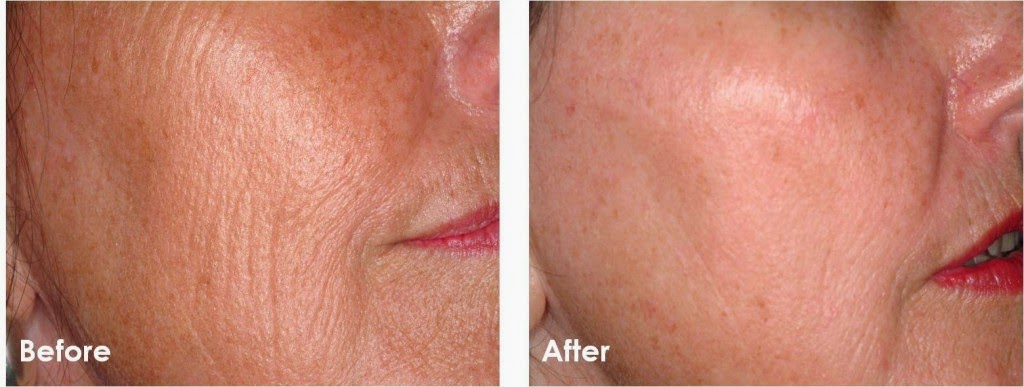
Before and Afters


 It is recommended that the procedure be done every 3 to 4 weeks (or once a month), which coincides with a normal skin cycle of approximately 30 days.  Along with sloughing away dead skin cells, dermaplaning can help reduce the visibility of acne scarring and slight wrinkling, as well as do away with extraneous vellous (translucent) hairs on the face.  If desired, the procedure can be followed with a chemical peel, though this could potentially cause the skin to peel due to over-exfoliation.
Is this right for you?

Dermaplaning is ideal for those with uneven skin, acne scarring, and fine lines around their mouth and eyes and removes  and peach fuzz on their face. Dermaplaning can also serve as an adequate treatment for men who suffer from razor burn and bumps caused by shaving.  However, because the procedure is a healthy treatment for the skin on your face, almost all people can benefit from the skin rejuvenation that dermaplaning promotes, no matter what skin color and skin type for any  male or female
.
Benefits

There are several benefits to blading that may make it the ideal method of skin exfoliation for you.  First of all, no chemicals are involved, which means less irritation for your newly sensitive skin.  Secondly, a session will generally last no more than 30 minutes and won’t leave you with a red, swollen complexion afterwards.  In fact, results can be noticed immediately.  Furthermore, because the blade being used is small, dermaplaning can target specific problem areas more easily and skillfully than other procedures that use larger instruments and focus on the face as a whole.  To top that off, dermaplaning generally costs around $100 per session, which is relatively cheap compared to similar procedures such as TCA peels ($800) and dermabrasion ($1,500 to $2,000). 

Get immediate results for minimal cost and no down time.


This treatment can be added to your skin rejuvenation regime of Microdermabrasion, glycolic peels, Meta therapy and beneficial facial treatments to intensify your results

Claude Thomas's  Med spa is known throughout the US for our innovative and forward thinking for the latest skin rejuvenation treatments and procedures

Claude Thomas Salon and Spa
33 E Northwest highway 
Palatine Il 60067
847-705-5999
www.Claudethomassalon.com


Monday, September 22, 2014

The "It" Cut for Fall/Winter

The "IT cut for this Fall and Winter


Movement, a full crown and a glamorously side-swept front: It's the '60s bob, and it's the "it" cut for fall/winter 2014.

click image to zoom
The look of this fashion was inspired by the shape over shape concept seen in fashion as well as the mixed medium of prints and sheers overlapping in one look and the unmistakable '60s vibe, so this hair cut  incorporates all these elements into a cut that is on trend, wearable and salon-friendly.
Weight and airy volume combine to make the "IT"  bob really stand out. It's not a replica of a 1960s bob; it's an updated version that has movement, is easy to style and looks fresh a couple days after shampoo because rounded layers are easily texturized.
TIPS FOR THE CUT
-Blowdry with Pureology Root Lift before cutting to better determine length and blending.
-Over direct layers up and over to the opposite side of the head and cut bluntly to create a rounded type of layer that encourages volume. Bottom layers will be shorter than the top.
-Layer first and create the perimeter second.
-Using zigzag sections below the part creates shorter pieces to compliment the long layers that fall over them for gracefully blended volume.

Sunday, August 3, 2014

Can You Wear This Hot Hair Trend?? YES!! What You Need To Know To Rock these Hair Colors

What's the hottest hair trend right now? It's candy-colored vibrant hair! 
This style has a way of transforming any outfit into a fashion statement. 
It's a bold, stylish way to showcase your individuality and have  everyone doing a double take.  HHere is a  guide to rocking this cool hair trend the right way!


HOW TO CHOOSE YOUR COLOR


• Pick a color you like and can wear easily. Stick to a "neutral" pastel color such as pink, peach, blue, violet, mint, etc. It will be easier to match your clothes and accessories with a softer color.
• Stick to one shade of color. If you want to get creative and dye your hair two different colors, be sure the colors blend well together -- such as blue and purple or blue and pink. Don't go for more than two colors at first.

• Make sure the color complements your skin tone. "Your skin tone is the basis to your hair so you want to make sure they complement one another," says Madame Claude. Does your skin have warm, more yellowish tone or does it have a cool, more pinkish tone? The more contrast between your hair color and skin tone, the more dramatic your look will appear. If you choose a hair color that is similar to your eye color or complements it, the combination will give a more natural look. It all depends on the look you are going for, not everyone wants the natural look.
• Consider different ways to highlight the hair. Think about whether you want to dye your hair one solid color or highlight it. Ombre gives a more natural blended look which starts with a darker color at the root of the hair to a lighter finish at the end using the same color tone.

• Make your  consultation with our stylist colorists. Choosing a hair color can be difficult and terrifying at the same time. If you're permanently dyeing your hair, you want to make sure you speak to our stylists about the color as well as the safest way to do it.


HOW TO MAINTAIN YOUR COLOR
To get candy-colored hair, you most likely have to bleach or use high lift tints on your hair. Bleaching your hair eliminatessome of your natural oils. Here are Madame Claude's tips on how to maintain and/or restore your hair's health after any high lift coloring


• The colder the better. It is better to wash your hair with cooler water.
• Use sulfate and parabin - free shampoos.
* Use the recommended  products (shampoos, conditioner, styling products and serums that your stylist recommends
• Use a deep conditioning treatment for your hair every time you wash your hair
• Avoid washing your hair everyday. Try to go some time between washes. If your hair gets dirty easily, use our recommended dry shampoo -- it can be a lifesaver.
• Put vinegar in your hair after dyeing it. Research shows that applying vinegar to freshly dyed hair can help the color hold better.
• Use heating tools properly. Such as hair straighteners and curling irons. Ask your stylist about the proper way to use your iron on your hair
• Use hair serums. Hair serums coat your hair and protect it from the heat caused when styling it. It also prevents everyone's worst nightmare: FRIZZ


HOW TO GET CANDY-COLORED HAIR WITHOUT DYEING IT

If you are not ready or do not want to commit with coloring your hair with high lift you can try some of these alternatives to permanently dyeing your hair

• Hair Chalking. Hair chalking is a quick, simple and an inexpensive alternative to dyeing your hair and it will wash out.
• Color hair extensions. These extensions will add that pop of color to your hair without having to color your own hair.


Monday, May 5, 2014

The Ten Commandments of Curly Hair and the Best Cutting techniques for Curly Hair


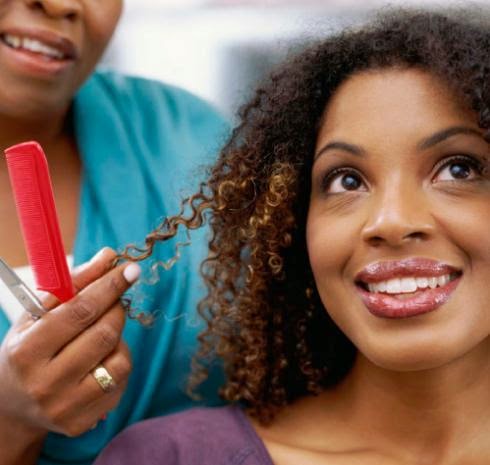
1. TOO MUCH TOUCHING. Curly hair does not react well to touch. Actually the more you run your hands through the bouncy locks, the more the roughing up the cuticle layer, causing more frizz and collapsing the curl.

2. DRINK UP. Curls need moisture! LOTS of moisture. When searching for curly hair products look for brands featuring high quality ingredients with a variety of oils to leave curly hair feeling vibrant and luxurious.

3. THE MORE THE MERRIER. Layering products creates a great effect for curls. For example, start with a leave in conditioner to balance the hair's moisture and eliminate frizz then go to a defining product to add fullness and movement rather than cocktailing the two together each product serves a purpose!

4. NO WET DOG LOOK. The infamous scrunch look is not desired by many but ends up being the result. No one with natural curls should look like they were left out in the rain.

5. WATCH OUT FOR THE LENGTH. Curly hair can be deceiving because you won't notice the growth until your "once in a blue moon" blowout, but the dead ends are still there and need to come off. A regular trim will bring back shape and life to the style.

6. BE AWARE. Not all curls are equal! Growth patterns and texture are different all over the head but especially with curls. Using products that not only enhance curls where needed, but also tame frizz .
7. START FRESH. Product build up will cause curls to loosen or flatten out. This can happen with any hair type. But when you notice your curls just aren't springing up like normal, make sure to cleanse the hair thoroughly prior to styling and check for waxes and silicones on the ingredient list of your at home product regimen.

8. CONFIDENCE IS KEY. For clients going natural, they are looking for you to validate their decision. One just needs to embrace what is natural.

9. BRUSHES STAY BACK. Brushing curly hair is not always necessary. Opt for a microfiber towel instead to blot dry and then continue to apply product.


10. EDUCATION. 65% of women have curl or wave in their hair! It's important to stay up-to-date with the latest in texture education.


Unique textures call for unique cutting techniques. 

Carve and Slice
Depending on the density of the hair, one slices—takes a little—or carves—takes a lot. The technique goes to the depth of the curl, following the curvature of the curl, allowing the curls to “puzzle” into each other.

Dry Cutting
The stylists prep for a curly cut by trusting their intuitive eye and their visual eye, says “Madame Claude” The owner and creative director of Claude Thomas Salon and Spa . “If the hair is wet, you’re not seeing it in its natural form, as you wear it.”


Lacing
 Lacing involves cutting into a wave formation and wave pattern in a freehand fashion. This loosens up the top of the hair without layering it. This technique starts with sectioning the hair on top of the head at either side of the part. The section is about two inches on each side of the part. No tension is applied to the hair as you cut in freehand to form a wave.  Lacing begins cutting from the ends of the hair toward the roots. Each section is treated separately, and only blend visually.

Tunnel Cut
Tunnel cut technique is designed for highly textured hair types. It is a controlled technique in which carefully selected pieces of the hair are removed from the bulkiest sections of the hair. This technique starts with playing with the hair to find out where it is most dense, looking for the natural part and the natural direction of hair growth. This information is vital so the tunnels will always remain invisible. Cutting the tunnels in the same place every time avoids the need for over cutting and over thinning. As the hair reaches the desired length, certain tunnels are no longer needed.

Freehand Slice
This technique will add more texture to hair, slicing into the hair toward the ends and point cutting straight down into the hair. The hair is held out at a 45-degree angle, letting it fall freely, slicing directly into the hair up to one to two inches from the ends.

Three more Techniques for cutting Curly Hair
• Bricking: In this bold technique, blunt (up to 1/4 inch) snips are made throughout a section to create space between the curls. This technique helps remove density by collapsing the shape.

• Stair Stepping: Vertical sections are cut short to long, one piece at a time, 1/4 inch deep, every 1 1/2 inches or so. “Use the tips of your shears and move along the section as in a  walking up or down  motion

• Whittling: Sections of hair are pinched or twisted, and the tips of the shears nip along the surface of the length of the section, without cutting all the way through. This technique doesn't remove length, it creates a thatch-like texture. It’s great for short and medium length curly hair.